“I have time for one more thing” can be a very convincing little liar.
Maybe you start folding laundry before leaving the house. Then a missing sock becomes a drawer-organizing mission, and suddenly your shoes are still off and the clock has opinions.
If that sounds familiar, let's make the next transition easier. You don't need to redesign your entire life before lunch.
ADHD can make planning, managing time, and remembering daily tasks difficult. These are recognized challenges, not proof that someone doesn't care. NIMH's guide to adult ADHD explains how they can affect everyday life.
1. Pick one thing your day needs next
A list of seventeen urgent things can make it hard to see a starting point. Try choosing one next action that fits the time you actually have.
“Deal with paperwork” is a whole project. “Open the form and find the deadline” is a place to begin. “Get everyone ready” can start with “Put the shoes by the door.”
Start with anything genuinely time-sensitive. Then make the first action small enough to name in one sentence.
What is the next thing I can actually do?
NIMH recommends writing down reminders, prioritizing time-sensitive tasks, and breaking larger tasks into smaller steps. Our one-thing approach is a simple way to try those ideas. Read the practical guidance.
2. Count the getting-ready time, too
A fifteen-minute drive is only the driving part. Shoes, bags, finding the keys, parking, and walking inside also need space in the plan.
Here's an example, with deliberately roomy estimates:
- Start getting ready
- 9:15 a.m.
- Leave the house
- 9:35 a.m.
- Arrive after a 15-minute drive
- 9:50 a.m.
- Appointment
- 10:00 a.m.
That leaves twenty minutes for getting ready and ten for parking and getting inside. Your actual trip may need more. Adjust for your body, your family, and the place you're going.
If your estimates keep being too short, time one familiar task once. Use the result as information for the next plan. This is curiosity, not a performance review.
3. Give the reminder a job
An alarm called “Reminder” leaves you another mystery to solve. Try naming the action instead:
- “Shoes on. Grab the bag.”
- “Save your work and close the laptop.”
- “Open the form. Just the first step.”
Choose a cue you can notice: a phone alarm, a visible timer, or a note where you start the task. Begin with one. If a cue fades into the background, change its wording, location, or format.
And when it is time to stop, write a tiny breadcrumb: “Next: finish question three.” Coming back is easier when you have left yourself a starting point.
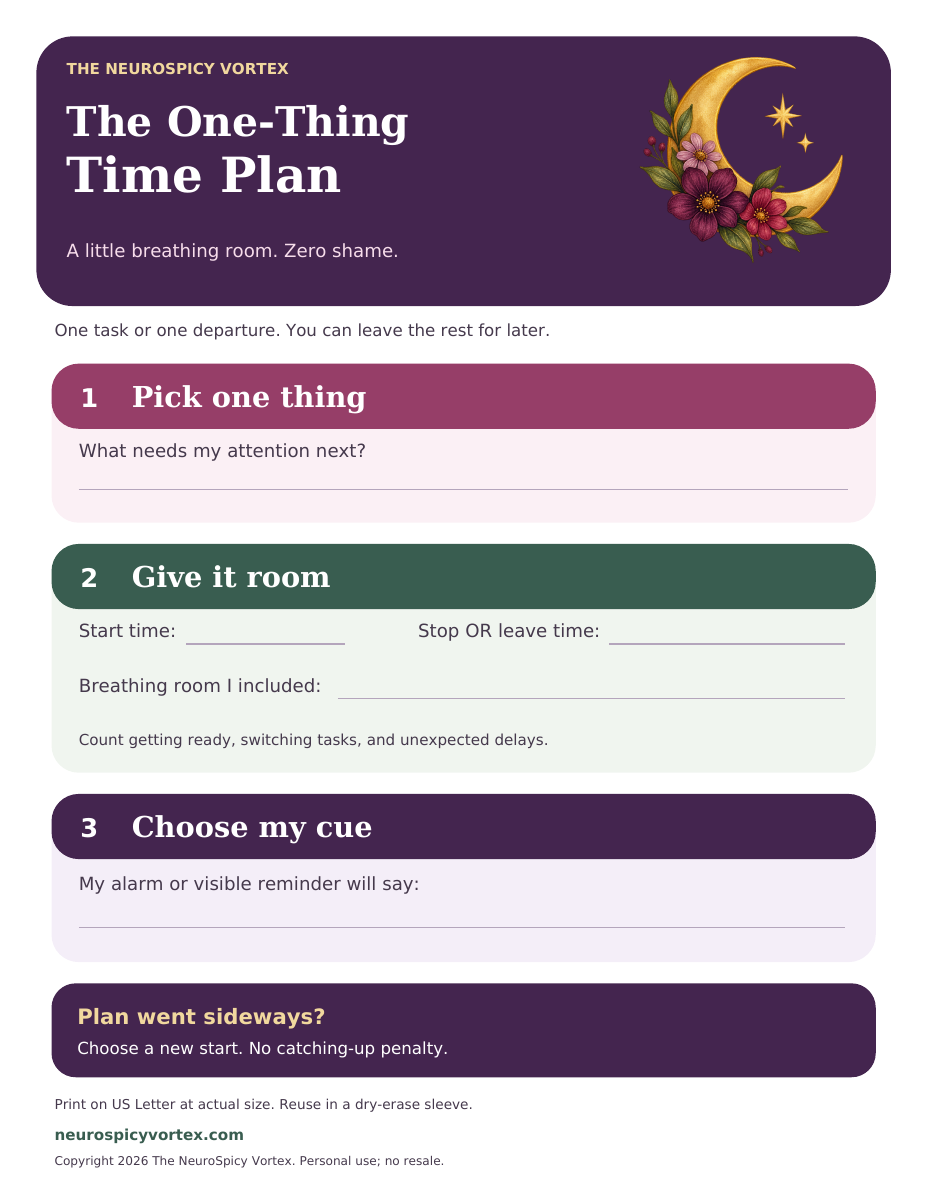
When the plan goes sideways
Kids need you. Energy drops. Something takes longer than expected. A missed start time doesn't mean the whole day is ruined.
Choose a new start, shrink the task, or move something that can wait. If another person is counting on you, let them know the revised plan.
You can care about your commitments and still need support keeping them. Both things can be true.
Give the plan some breathing room.
You are a human, not a countdown clock.
Want this approach for the kids, too? Try visible steps, calmer conversations, and our free chore-card kit.
 Jennifer Carrie Peterson, MS · Neurospicy Systems Strategist