Let's get one thing out of the way: parenting an ADHD child can be hard as hell.
Not because your child is bad. Not because you are failing. And not because either of you needs to try harder.
The problem is that most parenting advice was written for brains and households that operate in ways ours simply don't.
I'm a NeuroSpicy mom raising NeuroSpicy kids. I learned a long time ago that if a traditional system continually makes everyone feel like crap, we don't need more punishment—we need a better system.
1. Break the invisible project into visible steps
“Go clean your room” sounds like one instruction.
To an ADHD brain, it can feel like being handed an entire project with no starting point:
- Where do I begin?
- What counts as clean?
- Do I pick up clothes or dishes first?
- Where does this random thing belong?
- Why am I now sitting on the floor examining something I lost six months ago?
Instead of saying, “Clean your room,” we break it down:
- Pick up the garbage.
- Take out the dishes.
- Put dirty clothes in the hamper.
- Put clean clothes away.
- Clear one surface.
Clear, smaller instructions reduce the amount a child must organize and hold in their head. The CDC similarly recommends making assignments clear, shortening repetitive tasks, allowing movement, and using organizational tools for children with ADHD. CDC classroom guidance
At one point, we had two extra kiddos living with us, giving us four teenagers and four littles under one roof. “Everybody help clean” would have created complete freaking chaos.
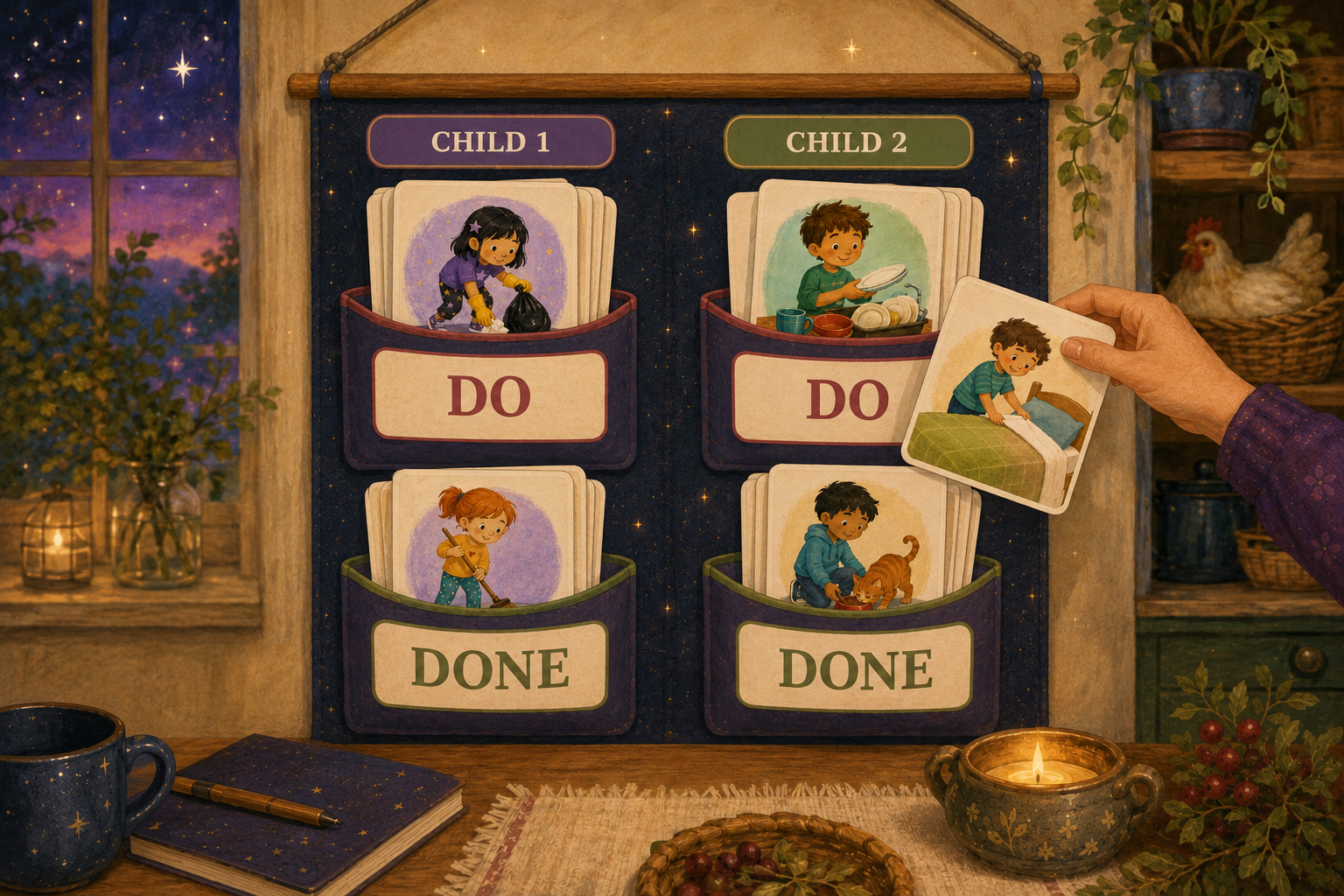
So we made chore cards.
Each card had a colorful cartoon picture on the front and step-by-step instructions on the back. Every child had a Do pocket and a Done pocket. During our weekly family meeting, the kids chose their chores for the next week.
Nobody had to remember the entire household system—especially their NeuroSpicy mother.
2. Regulation comes before conversation
What looks like a fit, tantrum, defiance, or refusal may be a child whose nervous system is completely overwhelmed.
Tone matters. The number of directions matters. The child standing in front of you matters.
I couldn't speak to every one of my children in exactly the same way and expect the same response. Each child needed their own path back to calm.

We used quiet corners and indoor tents instead of punitive timeouts. A quiet space wasn't where a child went because they were “bad.” It was a place to find their center before we tried to talk about what happened.
“You need to go find your center before you talk to me.”
When they were younger, we sometimes reminded them to breathe: in for six, hold for four, and out for six. One child added breathing charts to her quiet space.
Sometimes regulation meant breathing. Sometimes it meant crawling into an indoor tent. Sometimes it meant Mom sitting on the floor and offering a snuggle until their nervous system settled.
The conversation came afterward—not during the storm.
Managing emotions relies partly on executive-function skills, and children with ADHD may need help developing regulation strategies. CHADD's emotional-regulation overview
The goal isn't to force every child to calm down in the same way. It is to help each child discover what makes their body feel safe enough to reconnect.
3. Create rhythms instead of expecting automatic habits
Many neurotypical people can make tasks automatic by repeating them. Ever heard the idea that it takes just 30 days to create a habit? That isn't something NeuroSpicy people tend to experience. Repeated tasks may not become automatic as consistently.
In our house, we don't trust “habit” to remember everything for us. We build rhythms and routines, then use charts, lists, alarms, and visual cues to keep them moving.
A child may have brushed their teeth every night for six years and still genuinely need a bedtime chart.
They aren't lazy. They aren't careless. And they aren't “old enough to know better.” Their brain needs an external cue. There is no shame in using one.
The American Academy of Pediatrics recommends written chore lists and structured routines to help children with ADHD track what they need to do. It describes those supports as scaffolding—not babying. HealthyChildren.org home-organization guidance
But remember: the parent maintaining these systems may also be NeuroSpicy.
Our charts couldn't remain exactly the same forever. We changed them at least every season to keep them interesting. Our weekly family meetings gave us a chance to ask:
- What is working?
- What is making life harder?
- What should we change?
- Should we vote to try something completely different?
The system didn't need to work forever. It only needed to work for that season.
When the system stopped working, we changed the system—not the people.
Your home does not have to look “normal”

Homework didn't usually happen quietly at a desk in our house.
Sometimes reading happened upside down on the couch. Five minutes later, math might happen on the trampoline.
If learning is happening, who decided it has to look normal?
At one point, we had a queen-size bed and bunk beds in our master bedroom. Some of our children had racing thoughts and difficulty settling at night. Our sleeping arrangement looked unusual to other people, but our priority was creating a home where our children felt safe.
Adequate sleep remains important for children's physical and mental health, but families may need individualized routines and professional support when sleep is difficult. Sleep problems can also overlap with symptoms that resemble or accompany ADHD. CDC ADHD guidance
Your child's mental health matters more than impressing people with a perfectly normal-looking home.
Ask yourself:
- Is my child safe?
- Is my child healthy?
- Does my child feel loved and accepted?
- Does our environment help them function without constantly feeling broken?
Traditional homes and schools do not fit every ADHD child. That doesn't make the child defective.
Create a NeuroSpicy environment that adapts to the actual humans living inside it.
Use tools such as charts. Set alarms. Build that indoor tent. Try math on the trampoline. Change the chore system for the fifth time.
This sh*t is hard—but different does not mean wrong.
Sometimes different is exactly what allows a child to thrive.
 Jennifer Carrie Peterson, MS · Neurospicy Systems Strategist